No category

The Orange Trees Square

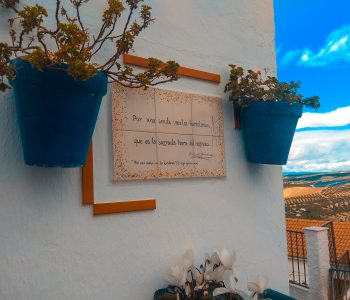
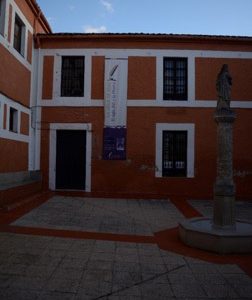
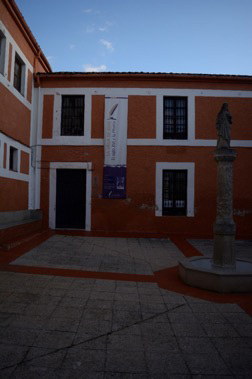
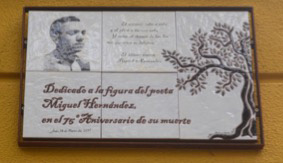
Continuing in a straight line along Calle Maestra, we turn and climb slightly up Calle Colegio until we reach Plaza de los Naranjos, a beautiful corner brimming with citrus fruits that give it its name and the only space where you can enjoy a beautiful ceramic plate dedicated to Miguel Hernández and complemented with a nice and brief extract from the poem “The last corner”:

(…)

The orange trees tastes like life and the olive trees tastes like time.

And in between their grieving

My passions collide.(…)
No category

Air-raid shelter

After the bombing of the city of Jaén by Francoist troops on April 1, 1937, which caused 159 fatalities and considerable material damage, measures were taken to prevent and minimize future air attacks: sound warnings, night-time darkness by turning off lights and the construction of several public underground shelters scattered throughout the city.

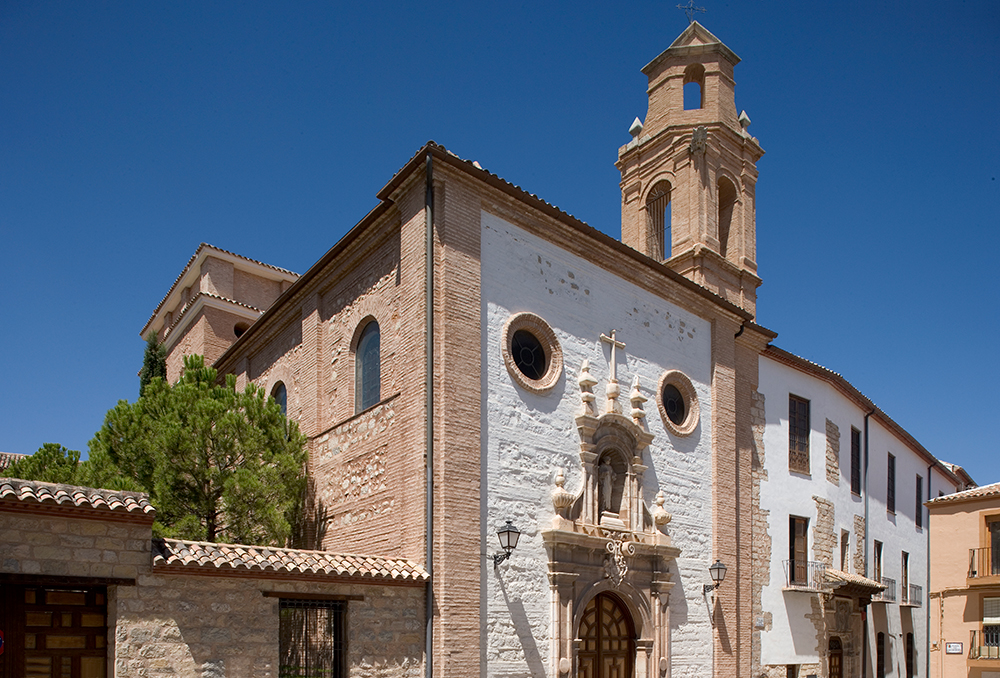
Shelters that, at the end of the war, were abandoned and even forgotten, with significant physical deterioration. One of them, located in the Plaza de Santiago, was built using the old crypts of the Church of Santiago. A shelter that had a capacity to accommodate up to 1,040 people in its different corridors in the event of a possible bombing.

This refuge has been recovered as a space for interpretation of the Civil War and as a place of historical memory of Andalusia. In its corridors you can see various photographs of the bombing, the tragic consequences it caused, as well as other testimonies such as front pages of the Southern Front or various poems by Miguel Hernández. The refuge can also be seen through a virtual visit:  http://www.bimnd.es/wp-content/uploads/Panorama/Refugio.html.

No category

Institute of Jaén Studies

Institute of Jaén Studies (Instituto de Estudios Giennenses – IEG) is an Autonomous Body of the Diputación de Jaén whose main function is the promotion and study of culture, science and art in the province of Jaén.

The IEG is introduced in this itinerary due to its work of documentation and custody of the Miguel Hernández Legacy. A legacy made up of 5,600 records and more than 26,000 images (collections of manuscripts, photographs, brochures, scores, historical press, sound recordings, etc.), with the intention of being a fundamental tool to promote studies and research on the figure and the work of the poet.

Although the Legacy can be consulted through the Internet: https://www.dipujaen.es/ miguelhernandez, it is possible to consult part of it in this institution, which has its headquarters in the Old Hospital of San Juan de Dios de Jaén, a 15th century building.

No category

Jabalcuz hot springs

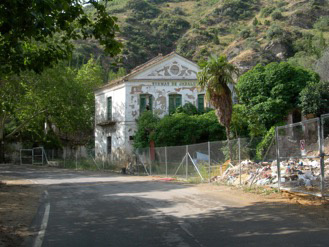
Although quite far from the proposed Hernandian urban itinerary, one of the places that are linked to Miguel Hernández and that deserve a visit are the Jabalcuz Hot Springs.

The hot springs were owned by the same owners as the building of his home and the Commissariat, so he may have known them for this reason. He used to walk or walk up there together with his wife, and sometimes bathed in a pool in the farm.

Josefina Manresa remembers these events in the book of her Memories: Memories of the widow of Miguel Hernández:

(…) We would go out for a while to the outskirts, to a party called Jabalcuz. There was a pool where Miguel bathed. Other times I typed. I wanted to teach myself. (…)

Currently, the Jabalcuz Hot Springs are in disuse, the historic garden being perfectly preserved, a place of incomparable beauty, while the building of the hot springs is in the process of restoration, improvement and enhancement. Not in vain, the historic garden is declared Asset of Cultural Interest.

No category

Miguel Hernández-Josefina Manresa museum

The Miguel Hernández-Josefina Manresa Museum is the main element that contextualizes the life and work of the Orihuela writer in the province of Jaén. Located on the ground floor of the building that also houses the Zabaleta Museum, it collects a large part of Miguel Hernández’s legacy.

The musealization responds to a chronological discourse that runs through the work and life of the poet and his wife, trying to convey the poetic sensitivity of Miguel Hernández and the depth of his life messages; the cultural value of his work and its social significance; the didactic dimension of the poet as an icon of the universal values ​​of the human being such as simplicity and constant personal effort, among others; and literature as a positive attitude towards life and as a tool for social and solidarity commitment.

This compendium of values ​​runs through six exhibition halls:

  • The reception area, where his main works are exhibited and a feedback panel synthesizes the life and work of the poet.
  • The “Perito en lunas” room, where aspects of his childhood and youth are exposed, as well as his first trip to Madrid and the influence that this causes in his work.
  • The “El Rayo que no cesa” (The Unending Lightning )room, where the museum discourse is marked by his relationship with Josefina Manresa, as a companion and poetic muse. The relationship with other poets and friends and the impact caused by the death of Ramón Sijé are also present.
  • The “Viento del pueblo”(The Village Wind) room, where the time that Miguel Hernández was in Jaén during the Civil War and the imprint it causes on his work is recreated. At this time he wrote the famous poem “Aceituneros”.(Olive Gatherers)
  • The room “Cancionero y romancero de ausencias”(“Songbook and ballads of absences”), where his dramatic prison via crucis is shown, illustrated with the recreation of a gloomy cell and where some of the beautiful verses he wrote during his captivity are exhibited, such as the famous “Onion Lullaby ”.

The tour ends in the room “The Poet’s Legacy”, a room for reading, workshops and audition, where you can see the impact of his work on a touch screen.

You can also enjoy the poet on the walls of the Museum, since there are different plaques with verses of his works on display that make the walk very enjoyable.

No category

Hernándian corners

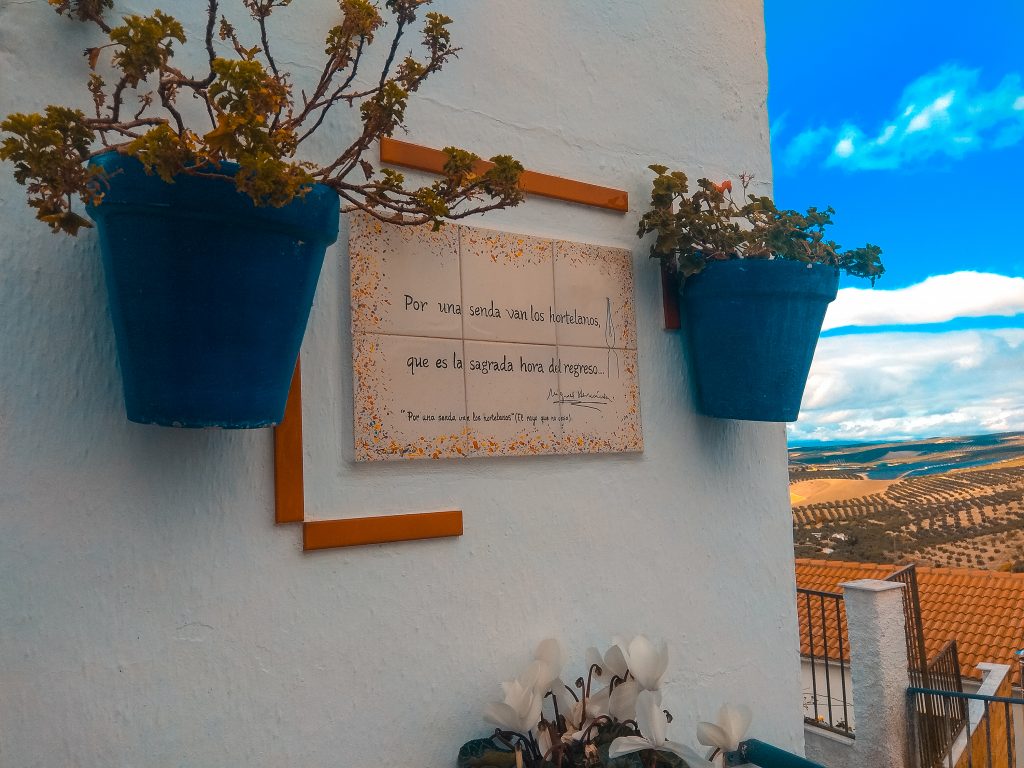
Quesada has a medieval neighborhood with narrow streets embedded in the terrain, snowy facades and huddled with orchards of pots, which make this town one of the most beautiful towns in the province, and there is no better way to get to know it than through Miguel Hernández and Josefina Manresa.

The city council has had the pertinent and timely initiative to further embellish the town through different mosaics in different streets of the Historic Centre, where you can read and contemplate verses and drawings by Miguel Hernández or passages from the memoirs of Josefina Manresa in relation to the town or author. An excellent way to get to know Quesada and enjoy reading the poet’s work, since the setting is unique.

.

No category

Panels and mosaics by Miguel Hernández

The Quesada town hall also pays tribute to the poet and Josefina Manresa through panels that inform and invite you to visit the Museum and through large mosaics, where the relationship between both with the town is explained. The mosaics located in the Plaza de la Constitución stand out, where the spaciousness of the space and the presence of a music band invite to recite the poet’s verses.

.

No category

Josefina Manresa`s house in Quesada

The house where Josefina Manresa was born is still preserved in Quesada, on January 2, 1916. A building that cannot be visited or has any type of museum, just a ceramic plaque where Quesada proudly shows the birth of his favorite daughter in that house.

.

No category

Monastery of San José del Salvador

Saint John of the Cross arrives at Beas as Prior of the Calvary Convent because Mother Ana de Jesús (whom he held in great esteem, so much so that he directs h Spiritual Canticle) considers the need to have the spiritual assistance of the most Discalced close to their community, because, as they were based in La Peñuela (La Carolina), so far from Beas, they were very rare.

The Calvary Convent has been completely altered and converted into a large farmhouse, conserving only some parts of it and a spring of water, which may well be the one that inspired the Carmelite saint stanza 35 of the Spiritual Canticle, which is engraved on the statue of Saint John of the Cross that is in the entrance square to the Monastery of San José del Salvador:

“Let’s rejoice, Beloved,

and let me see your beauty

through the mountain and the hill,

where pure water flows; let’s dive deeper into the thicket. ” (…)

The visit to Calvary is not available, yet it is in the Monastery of San José del Salvador of the Order of the Discalced Carmelites where the mystical poet acted as confessor and spiritual director of the nuns, the main historical space where to follow in the footsteps of the Saint and where he felt so comforted throughout his stay that he continuously returned to Beas to spend even long periods of time, as shown in some of the letters he regularly sent to the Carmelites.

(…) Do you think that, even though you see me so silent, I lose sight of you and miss the vision of how easily you can be saints, and how, with much bliss and safe protection you can walk in the delight of the beloved Spouse? (…)

Letter from Fray Juan to the Carmelites of Beas who reproach him for his delay and forgetfulness in replying them. (The Hundred Notices of Beas).

On the other hand, the Monastery of San José del Salvador was the tenth foundation of Santa Teresa and the first in Andalusia and its convent complex, its church, built during the first half of the seventeenth century, of a beautiful classicist baroque, stands out.

At the entrance square to the Monastery you can see the statue of Saint John of the Cross (and another of Santa Teresa) and inside, you can visit the museum-reliquary of the Monastery, housing remarkable various liturgical ornaments and relics of Saint John of the Cross, a bust of the Saint, a copy of the original drawing of Mount Carmel made by himself for Mother Magdalena del Espíritu Santo, nun of Beas, or the Book of Professions with seven unpublished autographs of the mystic poet, among other elements of interest.

You can also visit the parlor where Saint John of the Cross confessed and spiritually attended to the nuns. In it, there is a painting by the famous painter Ricardo Sanjuán, which represents the arrival of the Saint to Beas and the first interview with his nuns.

.

No category

Interpretation Center of the Villa de Beas, the 16th…

It is located next to the Sanctuary of the patron saint of the town, the Virgen de la Paz, in an old convent-school of Madres Calasancias, built in the 19th century on the remains of the old Castle and Fortress of Villa Vieja.

The Interpretation Center is divided into two different spaces, the History area and the Mystic area.

In the thematic area of ​​History, the visitor can explore aspects related to Beas de Segura, such as its history, the different noble families, the castle-fortress, the Order of Santiago and the Encomienda, the symbolism of the bull or the folklore of the town .

In the Mystic area, the figures of Santa Teresa de Jesús and Saint John of the Cross are the basis of this thematic space and you can visit the room of the dwellings and that of the mystical scale, and enjoy an allegory of the mystical garden , among other elements of interest.