No category

Residence in Gaspar Becerra street
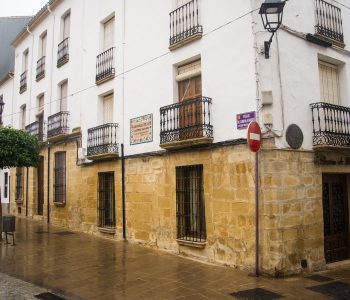
The professor’s salary did not allow Antonio Machado many expenses, so he soon had to leave the Hotel Comercio and look for rental accommodation.

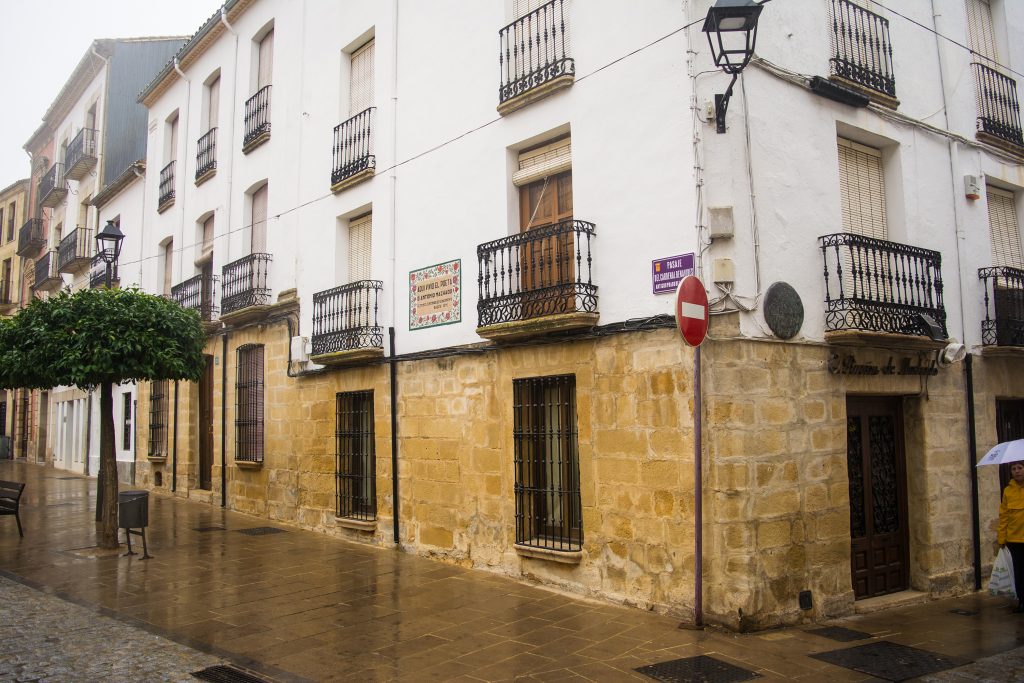
First, he rented a house to reside with his mother on Prado de la Cárcel Street (today Pasaje del Cardenal Benavides), but he found it ramshackle and cold, so he moved to another, although more modest, as he found it more comfortable and bright. An adjoining house on the same street, which was on the corner of Calle Gaspar Becerra, from where Machado could see the Plateresque façade of the old jail, today Baeza City Hall. He lived there, alone or temporarily accompanied by members of his family, until his transfer to Segovia in 1919.

Currently there is a mosaic (Pasaje del Cardenal Benavides) and a plaque (Gaspar Becerra Street) that recall the presence of the poet in this house.
No category

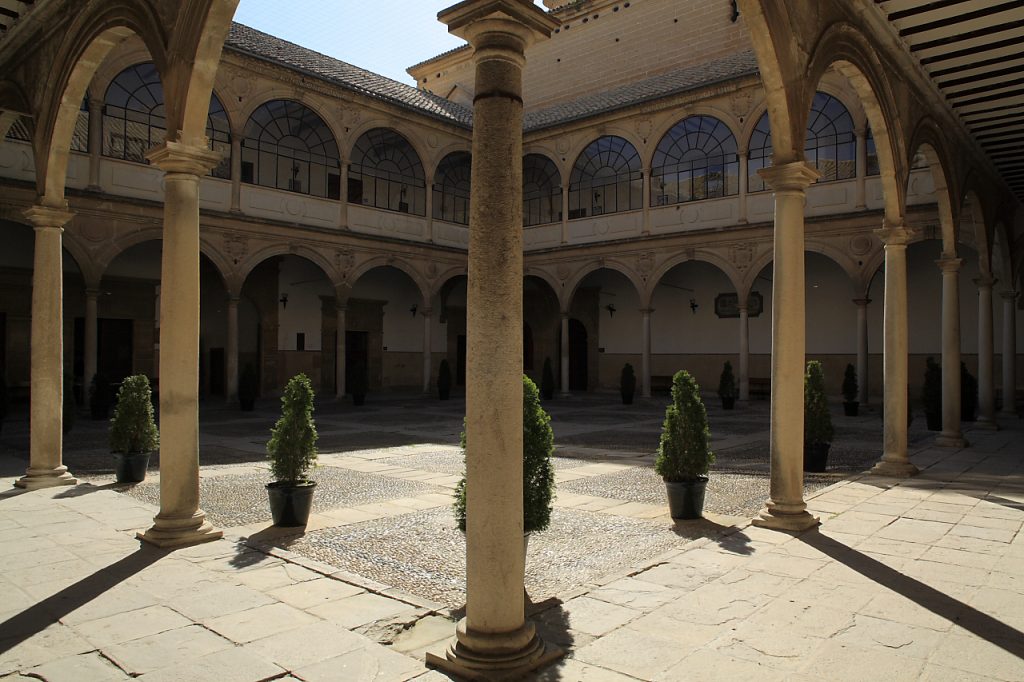
«Santísima Trinidad» Institute of Baeza

Machado arrived in Baeza to take possession of the French language chair called, at the time, General and Technical Institute, now the “Santísima Trinidad” Institute.

CXXVIII
POEM FOR A DAY

RURAL MEDITATIONS

(…) This humble teacher

at a rural high school

has always admired you,

oh Rector of Salamanca. (…)

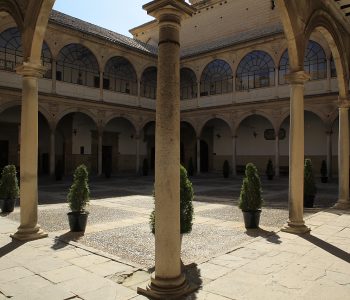
The center is located in what was the Renaissance headquarters of the old University of Baeza, with buildings added over time. The poet occupied a classroom on the ground floor to teach French, which is still intact and can be visited as a classroom-museum. In the classroom-museum, furniture, belongings and documentation related to Machado’s life as a teacher are exhibited: old desks, the teacher’s chair with a brazier (the classroom, like the town, is also damp and cold), wooden coat rack, umbrella…

No category

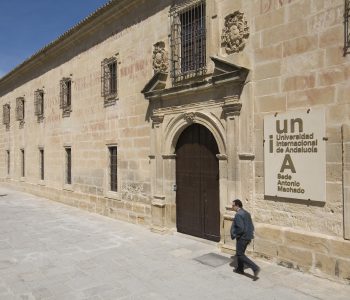
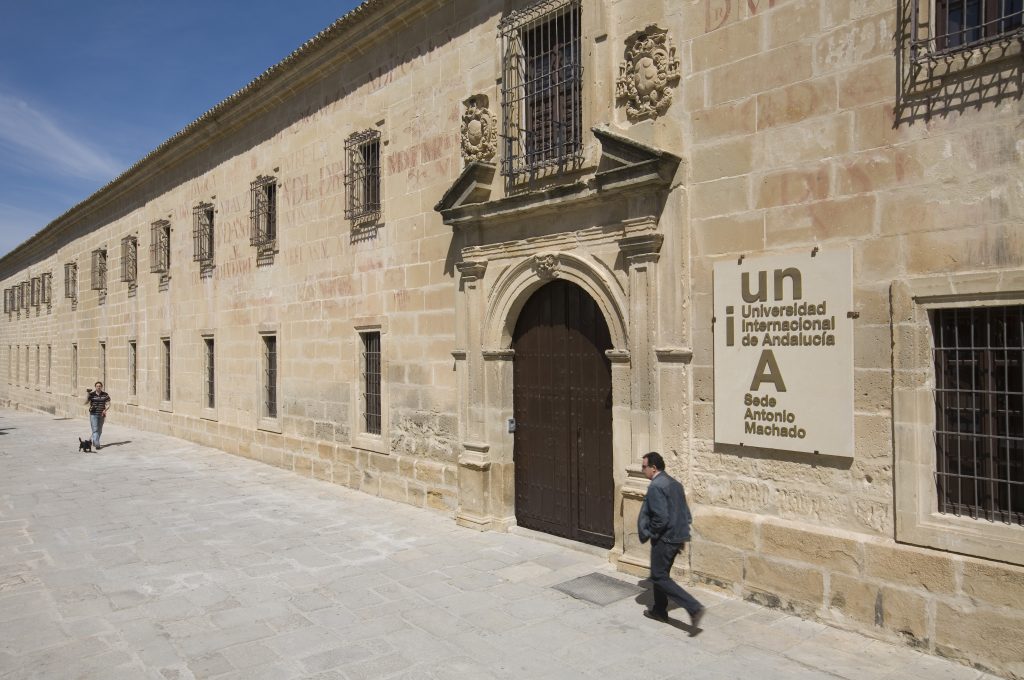
Headquarters of the International University of Andalusia “Antonio Machado”

The International University of Andalusia (UNIA) is an institution to support the Andalusian science and technology system in postgraduate training, research, knowledge transfer, digitization, permanent training and internationalization. In homage to the poet, the UNIA headquarters in Baeza bears his name.

The UNIA is located in two buildings: the Jabalquinto Palace, from the late 15th century and in the Renaissance style, and the Old Conciliar Seminary, a Baroque building nestled in the Plaza de Santa María, opposite the Cathedral -also Renaissance- and the High Town Hall -belonging to the Gothic-, both from the 17th century.

No category

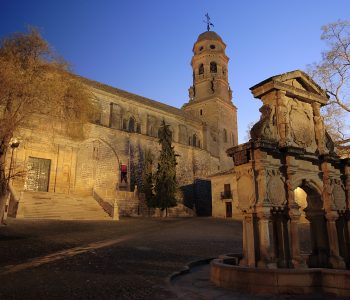
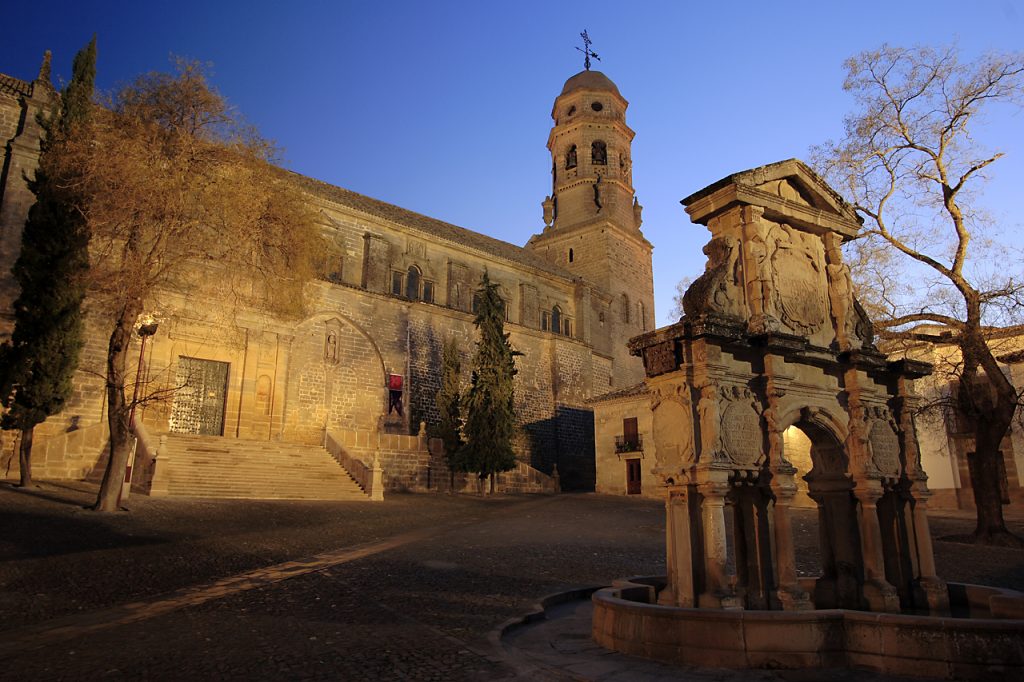
Plaza de Santa María and Cathedral

Machado let us learn that his hobbies were walking and reading. José Chamorro, in his work Antonio Machado in the Province of Jaén, attempts to reconstruct the poet’s itinerary on his walks: “the streets of Santo Domingo, San Pablo, San Andrés, Puerta de Úbeda, Arco del Barbudo, etc. .; highlighting “places as artistic and Spanish as the Plaza de la Catedral with its monumental fountain, erected with the majesty of a triumphal arch, a square as solemn as it is solitary with the moss of the old walls and the green grass between the slabs and stones of the pavement”.

During his wanderings through the historic center of Baeza, Machado has left some stanzas dedicated to this space, such as the famous poem of San Cristobalón.

NOTES III

III

Through a tall window

the owl flew

into the cathedral.

When he saw it was drinking

from the oil lamp

of the Virgin Mary,

Saint Cristobalón

tried to scare it away.

The Virgin spoke:

“Let it drink,

Saint Cristobalón.”

The Cathedral of Baeza, cultural Heritage since 1931, has been erected on successive buildings: a Roman temple, later a mosque, until its conversion to Christian worship in the 12th century. Since then it has undergone numerous architectural transformations up to its current state, with multiple elements from different periods, such as the Puerta de la Luna, in the Mudejar Gothic style.

The Puerta del Perdón( Forgiveness Door), in the Gothic style; or the main façade which is in the Renaissance style, which is its most dominant character. Andrés de Vandelvira collaborated in the Renaissance reform.

The interior of the Cathedral of Baeza also presents different styles, with Gothic pillars, ribbed vaults, Renaissance grills, Mudejar chapels and Renaissance chapels, as well as the main altarpiece, in the Baroque style.

Inside the Cathedral you can find the Cathedral Museum, which preserves pieces of great value and recognized prestige.

No category

Walk of the walls

Progressively, Antonio Machado got used to the rural environment of Baeza and its dazzling landscape outside the city. He enjoyed peri-urban walks that took him to the Cerro del Alcázar and over the remains of the old wall. One of the spaces most frequented by Antonio Machado, who walked it again and again in his meditation exercises.

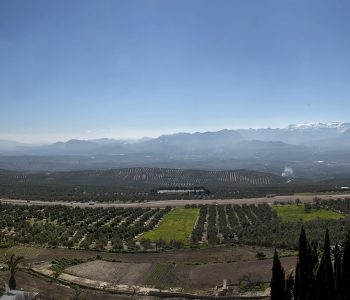
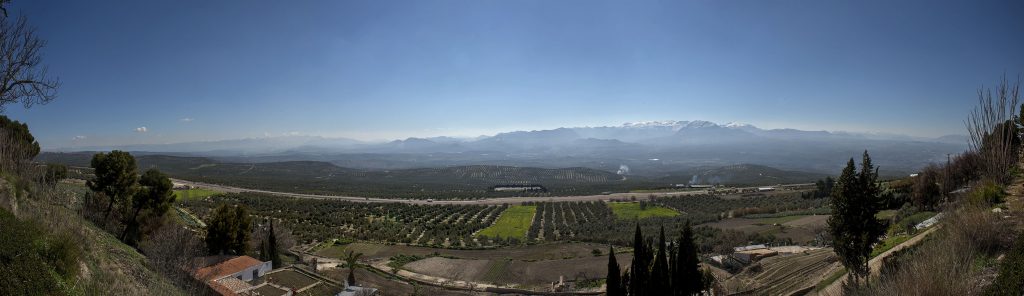
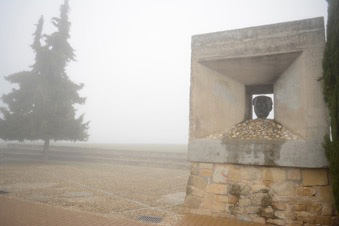
At one point along the walk, a plaque and a monument to Antonio Machado with a bust of Pablo Serrano remind us of the poet today. This sculpture was made to pay homage to the poet in 1966, although it did not arrive in Baeza until 1983. From the viewpoints of the promenade it dominates the middle valley of the Guadalquivir with its beautiful horizon carpeted with olive trees and cut out by the mountains of Cazorla, Mágina and Los Aznaitín and Jabalcuz mountains.

This scenery served as an escape and a boost to his creative capacity, as here he conceived sublime verses that describe this landscape.

ROADS

(…)

of the old Moorish city,

I contemplate the silent afternoon,

alone with my shadow and my grief.

The river is flowing

between shady gardens

and gray olive groves,

through the cheerful fields of Baeza.

The vineyards have golden vines

on the red stocks.

The Guadalquivir shines and reflects

like the pieces of a broken cutlass.(…)

Monumento a Antonio Machado en el Paseo de las Murallas
Events

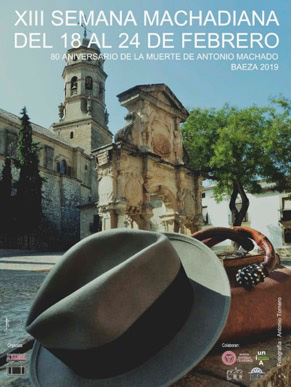
Machadian Week (celebrated in February)

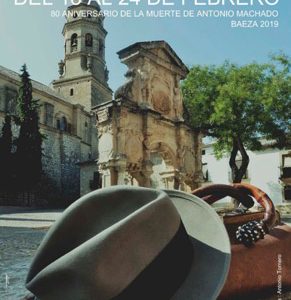
The Machadian Week is usually held around the time of anniversary of his death, on February 22. Different events are held, such as conferences, book presentations, flamenco and poetry recitals and other activities, among which a “Machadian walk” with a pre-established itinerary stands out, where various readings of his work are carried out along the way in the different Machado spaces. Times and venues vary depending on the activity.

Cartel de la Semana Machadiana 2019

Baeza has been culturally paying homage to Antonio Machado for decades. Already in February 1966, the city celebrated a tribute to Machado – prohibited by the Franco regime – with the presence of a large group of writers and artists. In May of that same year the authorities organized another tribute to the poet where some of his poems were recited, important academics intervened and a monolith – currently gone – was discovered in the courtyard of the institute where he taught. Later tributes brought together figures of culture such as the sculptor Pablo Serrano, the poet Rafael Alberti or the actor Paco Rabal.

The First Machadian Week was organized in1977, attended by actors, actresses, poets, guitarists, singers and many other personalities. A painting exhibition, theater performances, concerts were organized, the Antonio Machado poetry prize was created and a bas-relief was installed in the colonnaded courtyard of the allegorical institute to “Song of One Day”

Address: Different spaces in Baeza (IES Santísima Trinidad, UNIA, Montemar Theater, Town Hall and Paseo Machadiano).

Geolocation: City of Baeza

Organizing entity:

Baeza City Council with the collaboration of cultural agents such as UNIA, the Santísima Trinidad Institute and the educational centers of the town, where the figure of the poet is part.

information: 953 74 01 50

No category

Park on the way to Puerto de Tíscar

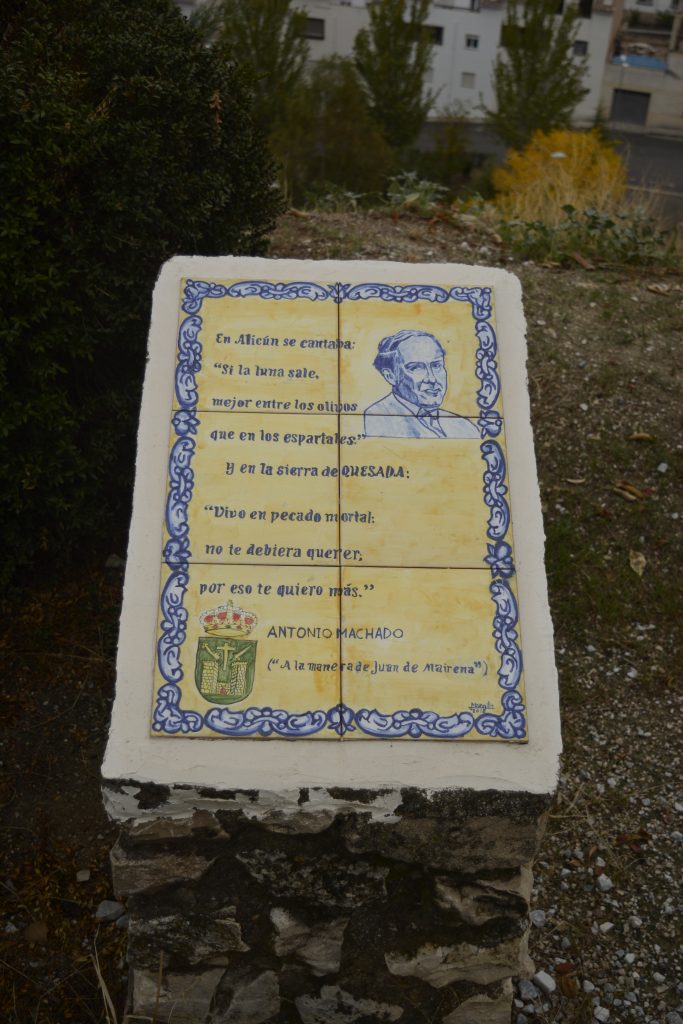
In a recently built park on the way to the port of Tíscar, the City Council of Quesada has honored Antonio Machado with some ceramics where fragments of the poem Apuntes para una geografía emotional de España are reproduced.

IN THE MANNER OF JUAN DE MAIRENA

NOTES FOR AN EMOTIVE GEOGRAPHY OF SPAIN

V
In Alicún they sing:

“If the moon is rising,

better under the olive trees

than in the esparto grass.”

VI

And in the Sierra de Quesada:

“I am living in mortal sin:

I ought not to love you;

therefore I love you more.”

No category

Sacred Chapel of the Savior

The Sacred Chapel of the World’s Savior)is the funerary pantheon of one of the most important figures of the time, Francisco de los Cobos, secretary of Emperor Carlos V. The temple is one of the most successful examples of the Spanish Renaissance, so it is a must see in Úbeda.

But what really links this temple to the figure of Muñoz Molina is its façade, where the representation of the “juancaballos” is carved, mythical creatures from the Sierra de Mágina that the author rescues to echo the phenomena and legends of the rural spaces. Although the real image chiseled on the facade is from Greek mythology, Hercules fighting a Centaur, to give greater emphasis to local history, the author unfolds a story that enhances the real possibility of its existence in the characters of the novel.

“The proof that the juancaballos existed […], was carved in stone, on the facade of the church of El Salvador, […], so that, if they had been sculpted in such a sacred place, together to the statues of the saints and under the relief of the Transfiguration of the Lord, my grandfather argued, smiling, you had to be a very heretic to not believe in them … “

Antonio Muñoz Molina. The Polish Horseman.

No category

Sculpture to the Fallen

The Town Hall square, also known as the Plaza de the Fallen for the sculpture it houses, stands between the Vázquez de Molina square, where you can find authentic Renaissance works such as the Sacra Capilla del Salvador and the San Lorenzo neighborhood. This is where Antonio Muñoz Molina lived his childhood and youth. A sculpture that is located in the center of the square and is dedicated to all those who died in the Spanish Civil War. It was made in 1951 by the Cadiz-born image master Juan Luis Vasallo.

The Ubeda author makes mention of this square and / or its sculpture several times in his work The Polish Horseman, both to evoke his usual route to the San Lorenzo neighborhood, and to recall interesting aspects in the novel.

“[…] and it was Don Mercurio who commissioned it […], an artist who later became very famous […], Eugenio Utrera, you may have got to know him, he also made the That monument in the Plaza de los Caídos […] “

Antonio Muñoz Molina. The Polish Horseman.

No category

San Lorenzo neighborhood

Going down Calle Cava, we find the peculiar neighborhood of San Lorenzo, a place where Antonio Muñoz Molina spent his childhood and which becomes another protagonist in his work, with its cobbled streets, white houses, churches and palaces … .

The author recreates in this neighborhood a literary space that is a key element to understand and interpret the action of the story, identifying specific spaces in the neighborhood such as the Cava gardens (both in Full Moon and in The Polish Horseman), the Church of San Lorenzo, the Puerta de Granada, the cobbled streets or its viewpoints.

The Cava gardens (both in Full Moon and in the Polish Rider).

(…) In the Cava gardens, around the statue of Second Lieutenant Rojas Navarrete, who looks straight north just as General Orduña looks south […] “

Antonio Muñoz Molina. The Polish Horseman.

The Church of San Lorenzo and the Puerta de Granada.

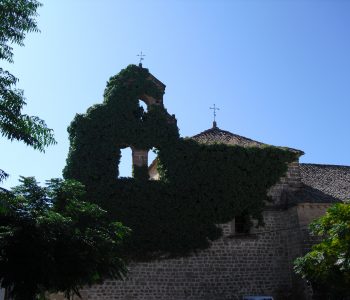
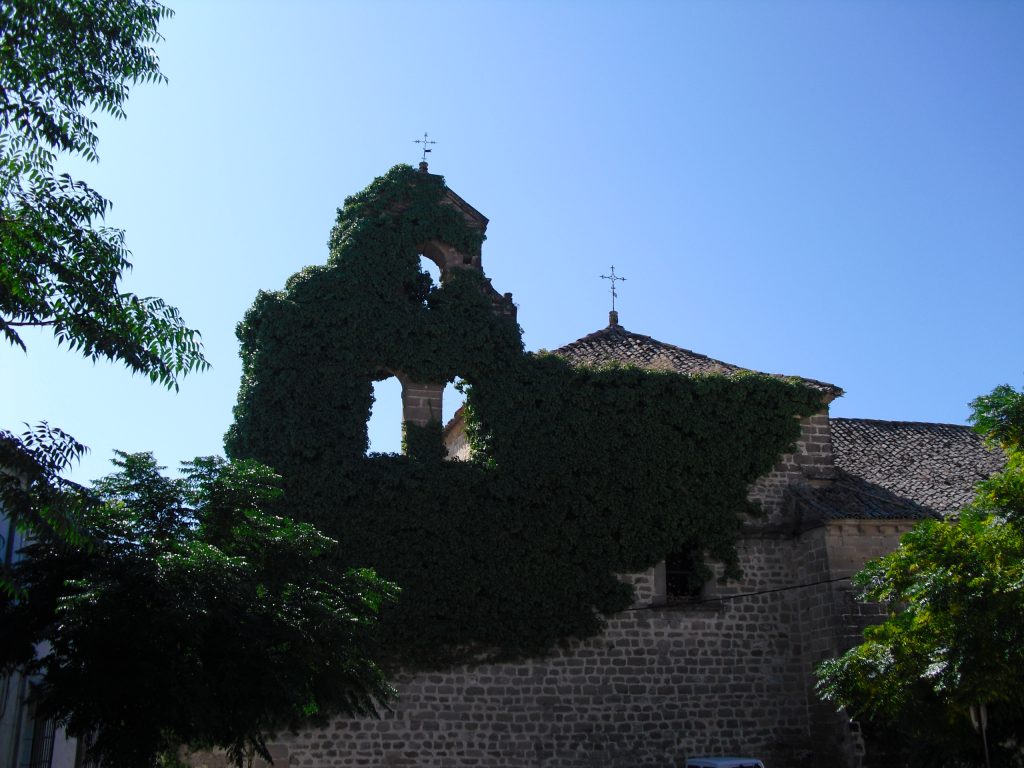
(…) Covered by ivy up to the cross of its pinnacle, the belfry of the church of San Lorenzo remains impossibly standing, but the pillar of the wall, next to the Granada gate […] “

Antonio Muñoz Molina. The Polish Horseman.

The cobbled and dark streets.