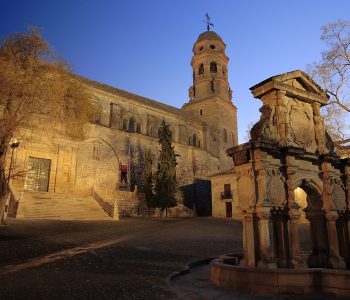
Plaza de Santa María (Cathedral of Jaén)

The above is not the only postcard in which Lorca refers to Jaén. In a postcard dated in Granada on November 7, 1925, once he had returned from his trip to Jaén and also addressed to his friend Melchor Fernández Almagro, the poet makes reference to various places and icons from Granada. Lorca exchanges the texts on the postcard with his friends and in it he reviews such identifying landmarks of Jaén as the Cathedral, the Plaza de Santa María or the relics of the Holy Face. Below is part of the text of the aforementioned postcard:

(…)

“Mac Donald continues his downhill slope of Grenadian disappointments. On the other hand, he has discovered the beauty of Jaén in pleasant company, with its graceful cathedral, open by hundreds of balconies to the streets and the square, crowned with apostles and prophets and guardian of the Holy Face, which we adore most solemnly. You can make the trip to kiss the glass where the Byzantine face of Christ emerges, oily and full of sweet intimacy among the old emeralds and rubies of the old Catholic frame. Wrapped, moreover, in the silky anointing of the liturgy. Granada no longer exists. Granada is possession, Jaén is unity.
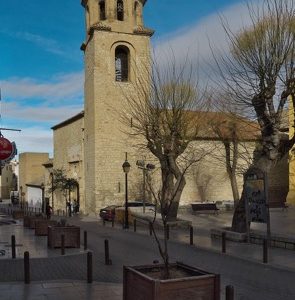
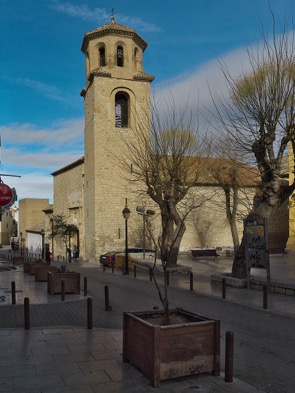
La Magdalena church

On November 24, 1925, Federico García Lorca dated another collective postcard, from a second trip of the poet after the one that occurred at the beginning of November and showing his interest in the city, which left him a pleasant memory. In this new visit, where Lorca acted as Guide, he was accompanied by José Segura Soriano, Alfonso García Valdecasas, Miguel Pizarro Zambrano and Adelina Bello.

From this brave city where I came by car, your friends hug you and greet you. I look forward to your letter. Tell me what you think of the gentleman Paquito. Goodbye. Frederick. This new postcard has the image of the old Arab minaret of the Church of the Magdalena (a primitive mosque in the city, converted to church after the Christian conquest), located in the neighborhood of the same name.

Link with Juan Eslava Galán

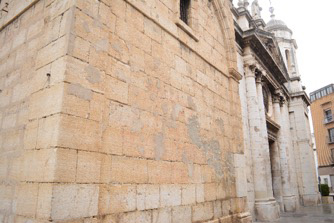
Place of Santa María (Cathedral de Jaén)

En la plaza de Santa María se ubica la Catedral de Jaén, el gran monumento de la ciudad, por lo que no escapa al interés de nuestros escritores. Por ejemplo, Juan Eslava Galán utiliza estos espacios para contextualizar lugares y acciones en sus obras; Federico García Lorca los reseña en sus postales cuando viaja por Jaén y Miguel Hernández la refleja en sus artículos sobre el bombardeo de Jaén

Vínculo con Federico García Lorca

Vínculo con Miguel Hernández.

Vinculo con Juan Eslava Galán

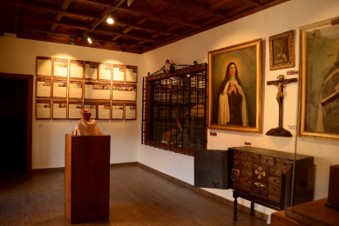
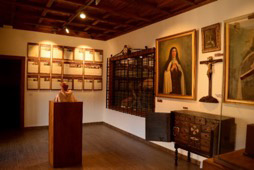
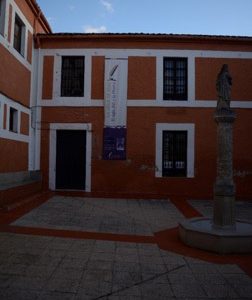
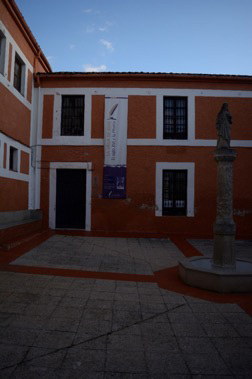
Monastery of San José del Salvador

The Monastery of San José del Salvador represents a fundamental milestone in the foundations of Saint Teresa, since it was the first in the Andalusian geography, as well as the place where Saint John of the Cross acted as confessor and spiritual director of the Carmelite nuns. Link with Saint John of the Cross Link with Saint Teresa of Jesus

Vínculo con San Juan de La Cruz

Vínculo con Santa Teresa de Jesús

Basílica of San Ildefonso

Esta Basílica, declarada Basílica Menor en el año 2010 por el Papa Benedicto XVI tiene mucha vinculación con nuestros autores por varios motivos. Todavía se pueden ver en la fachada los daños causados por la metralla causada en el bombardeo de Jaén, por lo que es un excelente lugar para contextualizar por qué llega Miguel Hernández a la ciudad. Por otro lado, tanto el arrabal, el cementerio como la iglesia de San Ildefonso, son espacios donde Juan Eslava Galán describe el episodio de la “Virgen que se paseó por Jaén”.

Vínculo con Miguel Hernández.

Vínculo con Juan Eslava Galán

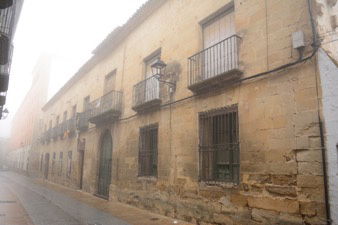
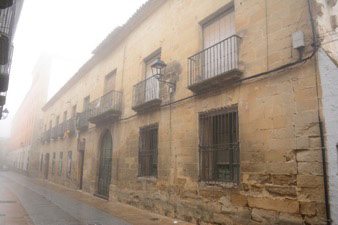
Hospice of Discalced Carmelites

This place, where the Hospice for the Discalced Carmelites was built at the expense of the nuns, is posterior to the stay of Saint Teresa and Saint John of the Cross, but it is an important landmark in the Teresian places, in addition to being located on Saint John of the Cross Street.

Vínculo con Santa Teresa de Jesús

Vínculo con San Juan de la Cruz

Old Artisan Casino

El antiguo Casino de Artesanos, hoy desaparecido, fue testigo de excepción, de uno de los episodios más singulares del paso de Machado por la ciudad. Ahí se encuentra con un joven Federico García Lorca, en esos momentos, todavía más músico que escritor.

Vínculo con Antonio Machado

Vínculo con Federico García Lorca